
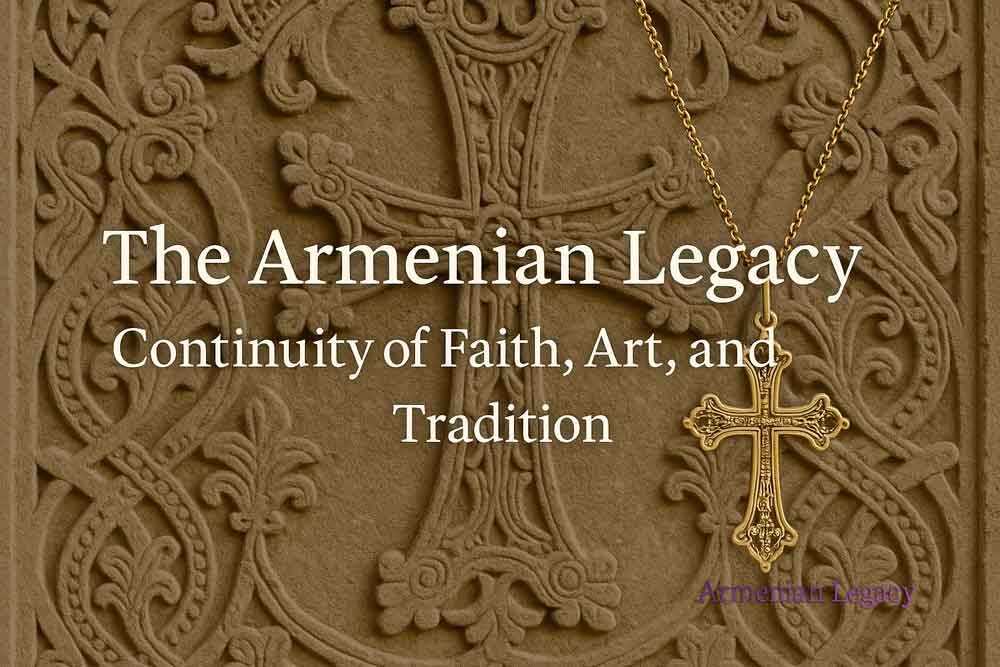
When we speak of “legacy,” we refer to what endures — the values, traditions, and cultural expressions that transcend generations. For Armenians, legacy is not simply about preserving relics of the past; it is about living continuity. Across centuries marked by triumphs, hardships, and global dispersion, the Armenian people have nurtured a cultural identity that remains vibrant. This identity rests on three enduring pillars: faith, art, and tradition. Together, they form the essence of the Armenian legacy — a legacy that speaks both to Armenians themselves and to the world at large.
Faith as the Foundation of Armenian Legacy
For Armenians, faith has always been more than a matter of religious practice; it has been a foundation of national identity. In the ancient world, before the arrival of Christianity, Armenians honored a pantheon of gods and goddesses tied to nature, fertility, war, and wisdom. Deities such as Aramazd, Anahit, Vahagn, and Astghik shaped the worldview of early communities, embedding moral codes and explanations of natural order into the lives of ordinary people.
The turning point came in 301 CE, when Armenia became the first nation in the world to adopt Christianity as its state religion. This watershed moment profoundly shaped Armenian civilization. Christianity provided spiritual guidance and also became a force of unity, strengthening cultural resilience during centuries of political upheaval.
Symbols of the cross quickly became central to Armenian life. They appeared in manuscripts, stone carvings, and church architecture, embodying both faith and survival. For Armenians, the cross was not just a theological emblem — it was a reminder of endurance, hope, and identity. Faith, therefore, has never been static; it remains the living foundation of the Armenian legacy.
Art as Cultural Memory
If faith formed the foundation, art became the vessel of memory. Armenia’s artistic heritage is vast and diverse, yet it consistently reflects devotion, resilience, and creativity.
Among the most distinctive contributions are the khachkars, or cross-stones. These intricately carved monuments, found in churchyards and mountain passes alike, are masterpieces of spiritual symbolism. Each khachkar is unique, blending crosses with floral, geometric, and eternal motifs. Recognized by UNESCO as part of the world’s intangible cultural heritage, khachkars remain visible markers of Armenian artistic genius.
Armenian art also flourished in illuminated manuscripts, which combined sacred text with dazzling miniature paintings. Monks and scribes adorned Bibles, chronicles, and theological works with brilliant colors and symbolic imagery. These manuscripts not only preserved religious devotion but also safeguarded history, philosophy, and cultural memory in times of upheaval.
Beyond sacred works, folk art thrived through embroidery, carpet weaving, ceramics, and metalwork. Everyday objects became carriers of meaning, their patterns and motifs tying families to a deeper cultural identity. Art, in this sense, was not merely decorative — it was the embodiment of Armenian continuity.
Tradition as a Living Heritage
Tradition gives continuity its rhythm. In Armenia, traditions are not relics but practices woven into the fabric of daily life.
Perhaps the most defining tradition is language. The Armenian language belongs to its own unique branch of the Indo-European family, with no close relatives. Its distinctiveness was solidified in the early 5th century CE, when Mesrop Mashtots invented the Armenian alphabet. This monumental achievement allowed for the translation of sacred texts and sparked a Golden Age of literature, ensuring the survival of Armenian thought and identity across centuries. Language became a portable homeland, uniting Armenians even when scattered across continents.
Music and dance are equally central. The haunting tones of the duduk, recognized by UNESCO, carry the soul of Armenia in every note. Folk dances, often performed in circles, symbolize community, continuity, and resilience. These traditions survive in both Armenia and diaspora communities, where they bind new generations to their roots.
Festivals provide another form of continuity. Vardavar, for instance, once celebrated the goddess Astghik and later reinterpreted within Christian tradition, involves joyful water rituals across towns and villages. Weddings, too, embody continuity — with rituals, songs, and feasts that link families to centuries of cultural practice.
The Armenian Legacy Across Time and Place
Few nations have faced as many trials as Armenia. Positioned at the crossroads of empires, Armenians endured invasions, partitions, and forced migrations. Yet the legacy of faith, art, and tradition proved remarkably resilient.
The Armenian Genocide of 1915 was a devastating attempt to erase identity, yet survivors carried their culture with them into exile. Across the Middle East, Europe, and the Americas, diasporic communities rebuilt schools, churches, and cultural centers. These became beacons of continuity, ensuring that Armenians abroad remained tethered to their legacy.
Even in new homelands, symbols remained vital. Communities raised khachkars in cemeteries, built churches in familiar styles, and carried sacred motifs into daily life. The Armenian cross, distinguished by its flared arms and intricate vine-like designs, remained a defining marker of identity. In the modern era, this tradition of carrying sacred symbols has also found expression in jewelry. While Armenians historically favored their own unique cross forms, many today wear pieces identified in the wider Christian world as an Orthodox Cross Necklace, blending personal devotion with a broader tradition of faith-inspired adornment.
Today, the Republic of Armenia serves as the anchor of national heritage, while diaspora communities continue to nurture and adapt traditions worldwide. Cultural organizations, scholarship, and digital archives bridge past and present, linking the ancient homeland with Armenians across the globe.
Why the Armenian Legacy Matters Today
The Armenian legacy is more than a national story; it carries universal meaning. It reflects the broader human struggle to preserve culture and memory amidst adversity. It demonstrates how small nations can contribute profoundly to world civilization through resilience, creativity, and adaptation.
Faith illustrates the power of belief to unite communities. Art demonstrates how creativity can transform hardship into beauty. Tradition reveals how culture can evolve without losing its essence. Together, these elements offer lessons for humanity on the importance of identity and cultural preservation in a rapidly changing world.
Furthermore, Armenian legacy enriches global diversity. Through its history, mythology, art, and language, Armenia offers insight into ancient trade, the spread of religions, and the cultural interplay between East and West. By engaging with Armenian heritage, we learn not only about Armenia but also about the shared history of humankind.
The Armenian legacy is not confined to history books or museums — it is a living continuum. It is faith carried through centuries, art that transforms memory into form, and traditions that adapt yet endure. It is the resilience of a people who, despite exile and loss, rebuilt their culture across the globe.
To speak of Armenian legacy is to speak of continuity — of a cultural thread unbroken by time, strengthened by adversity, and made luminous through faith, art, and tradition. It is a legacy that belongs not only to Armenians but to all who value the enduring power of heritage in shaping identity and meaning.